
Demonstrations Held In Texas City Following ICE Incident
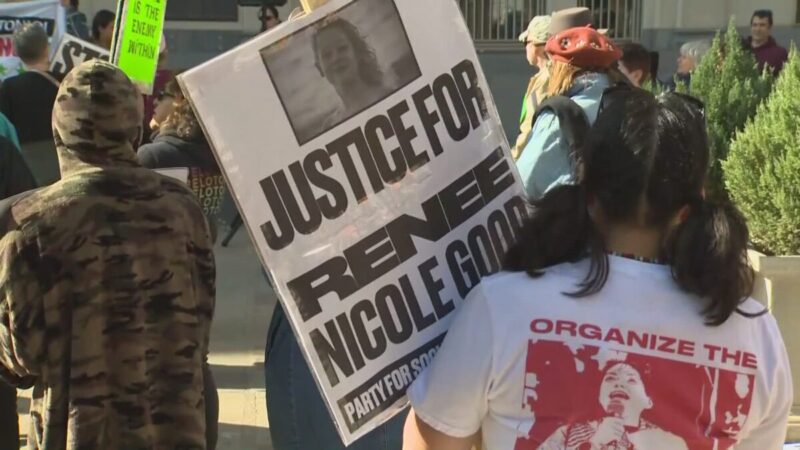
In a scene both emotionally charged and politically revealing, nearly two hundred members of the Party for Socialism and Liberation (PSL) gathered in downtown San Antonio this weekend to protest the recent ICE-involved shooting in Minneapolis — a fatal incident that has now become a rallying cry for anti-ICE activists nationwide. The protest, one of hundreds organized across the country on Saturday, reflects a growing convergence of radical leftist activism, immigration enforcement backlash, and broader geopolitical grievances.
At the center of the protest was a makeshift memorial for Renee Good, the woman fatally shot after reportedly driving her vehicle toward an ICE agent who was enforcing federal immigration law. While federal authorities described the agent’s action as a defensive use of force, the PSL and its supporters framed the shooting as an unjustified killing.
Chants of “Justice for Renee Good!” echoed through San Antonio’s Plaza near City Hall as attendees lit candles, placed flowers, and displayed signs declaring “We the people saw the video.”
But the protest’s scope extended far beyond the Minneapolis shooting. Attendees — some wearing Palestinian keffiyehs, others in Brown Beret uniforms — broadened the narrative to encompass U.S. foreign policy in Venezuela, the arrest of Nicolas Maduro, and recent federal raids targeting the Tren de Aragua gang.
That gang, a violent Venezuelan criminal organization, has become a focus for federal immigration and criminal enforcement efforts in Texas and beyond. In December, a raid in north San Antonio led to the arrest of 51 gang members operating out of an illegal nightclub — an operation the PSL also opposed.
The presence of the Brown Berets, a pro-Chicano paramilitary group known for their militant rhetoric, added a provocative layer to the protest. The blending of slogans protesting both ICE and U.S. military operations abroad signals an increasingly intersectional approach among far-left groups — one in which domestic immigration enforcement, foreign policy, and socialist ideology are seen as part of a single oppressive system.
Organizers’ swift pivot from pro-Hamas demonstrations during the Gaza War to anti-ICE protests surrounding the Venezuelan diaspora suggests both ideological consistency and tactical opportunism. The PSL’s message is clear: oppose American interventionism in all forms, whether it takes place in the Middle East, Latin America, or the streets of Minneapolis and San Antonio.

Yet this form of protest, emotionally charged and visually theatrical, underscores the complex collision between immigration enforcement and political narrative.
Renee Good, who allegedly attempted to strike a federal officer with her vehicle, is memorialized not as an aggressor but as a martyr. And ICE agents, under constant political and physical pressure, are cast as symbols of systemic oppression — regardless of the legal realities on the ground.