
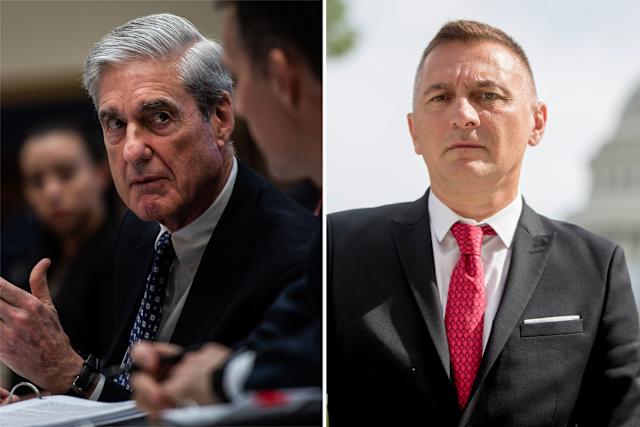
DOJ Makes Correction To Mueller Report
Nearly seven years after the release of the Mueller report, the Justice Department has quietly issued a correction to one of its most controversial references — a footnote connected to the widely discussed allegations that Russia possessed compromising material on Donald Trump.
The understated change, made without public announcement, modifies a factual detail that had been embedded in the report since 2019 and played a role in the swirling narrative surrounding the so-called “Steele dossier.”
The correction concerns Giorgi Rtskhiladze, a Georgian-American businessman whose name appeared in footnote 112 of Special Counsel Robert Mueller’s report on Russian interference in the 2016 election. The footnote referenced communications between Rtskhiladze and former Trump attorney Michael Cohen related to rumors of alleged tapes from Moscow tied to Trump’s 2013 visit for the Miss Universe pageant.
In the original report, Rtskhiladze was described as a “Russian businessman.” The Justice Department now acknowledges that description was incorrect. A brief notice added to the agency’s archived report states that Mueller’s investigation “incorrectly identified” Rtskhiladze as Russian when he is in fact Georgian-American.
The correction, issued in December following a prolonged legal dispute, is the only official amendment made to the 448-page Mueller report since its publication. It appears at the bottom of the Justice Department’s archived version of the document and was not accompanied by any public announcement or press statement.
For Rtskhiladze, the change represents partial vindication after years of legal and reputational battles. He filed a defamation lawsuit against Mueller and the federal government in 2020, arguing that the misidentification contributed to public perceptions that he was linked to Russian intelligence or acting as an intermediary in a potential kompromat operation targeting Trump.
The allegation stemmed from the now-famous Steele dossier, compiled during the 2016 election by former British intelligence officer Christopher Steele. The dossier included explosive claims that Russian authorities possessed compromising recordings involving Trump and prostitutes in a Moscow hotel room. Although the claims were never verified, they became a dominant theme in media coverage during the early years of Trump’s presidency.

Rtskhiladze’s communications with Cohen were included in the Mueller report as part of the broader discussion of those rumors. One text message cited in the footnote said he had “Stopped flow of some tapes from Russia.” According to Rtskhiladze, the report omitted the word “some,” altering the tone and context of the message. He has maintained that the exchange was merely passing along unverified rumors circulating in Moscow at the time.
While the defamation case did not result in financial damages, the U.S. Court of Appeals for the D.C. Circuit ruled that Rtskhiladze had standing to pursue his claim, reversing an earlier dismissal. He is now seeking reimbursement for legal fees after the government issued the correction.