
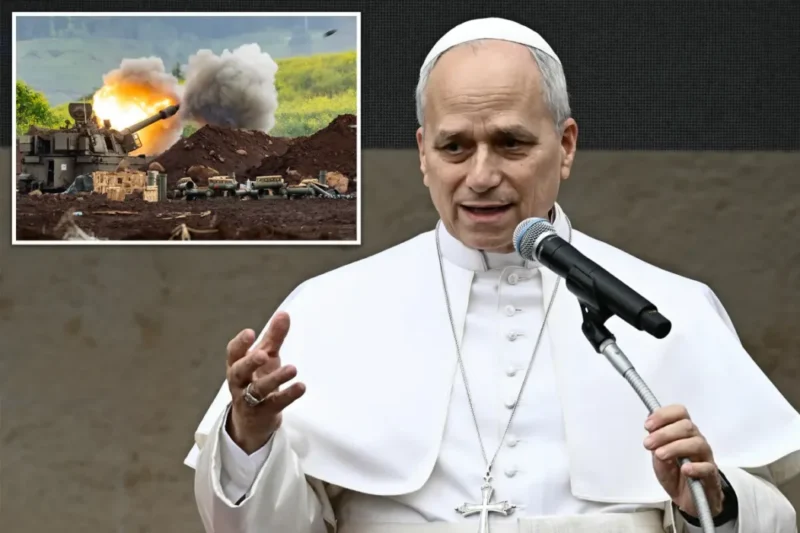
Pope Leo Announces The Vatican’s Position On The Iran Conflict
The call came at a moment when the world was already straining under the weight of escalating conflict, and Pope Leo XIV chose his words with a clarity that signaled both urgency and restraint.
Standing before the faithful at the Vatican during his traditional Sunday noon blessing, the pontiff delivered what has now become his most direct and forceful appeal since the outbreak of war involving Iran—an unmistakable demand for an immediate ceasefire.
For two weeks, Leo had walked a careful diplomatic line, echoing the Vatican’s long-established posture of neutrality. His earlier statements emphasized peace in broad, almost timeless terms, deliberately avoiding the naming of nations or the assigning of blame. But the mounting toll of civilian casualties, particularly those involving children, appears to have shifted the tone. This time, the message was sharper, more immediate, and impossible to misinterpret.
His reference to deadly strikes on schools and civilian areas carried particular weight. Though he did not explicitly name the actors involved, the implication was clear enough to resonate globally. Reports of an early strike hitting a school in Iran, killing more than 165 people—many of them children—have already stirred international concern, especially amid revelations that outdated intelligence may have played a role. The ongoing investigation into that incident lingers as a grim reminder of how quickly modern warfare can spiral beyond control.
Leo’s language expressed a moral argument rather than a political one. “Violence can never lead to the justice, stability, and peace that the people are waiting for,” he said, framing the conflict not as a strategic contest but as a human tragedy unfolding in real time.
His emphasis on reopening “avenues for dialogue” reflected a belief deeply rooted in Vatican diplomacy: that even the most entrenched conflicts must ultimately be resolved through negotiation, not escalation.
Beyond Iran, the pope’s concern extended to Lebanon, where rising tensions threaten to ignite a broader humanitarian crisis. For the Vatican, this carries additional significance. Christian communities in southern Lebanon represent not only a religious minority but also a تاریخی and symbolic presence in a region often defined by sectarian divides. Their vulnerability amplifies the stakes of the conflict in ways that transcend geopolitics.

While Leo maintained the Vatican’s official neutrality, other prominent Catholic voices have been less restrained. Cardinal Robert McElroy labeled the war morally unjustifiable, while Cardinal Blase Cupich criticized the tone of political messaging surrounding the conflict, particularly imagery that appeared to trivialize its severity. These internal differences highlight the tension between diplomacy and moral clarity—a balance the Vatican continuously navigates.
Meanwhile, Cardinal Pietro Parolin’s remarks reinforced the Holy See’s unique role as a diplomatic bridge. By maintaining communication with all parties, including the United States and Israel, the Vatican positions itself as one of the few institutions capable of speaking across entrenched divides.