
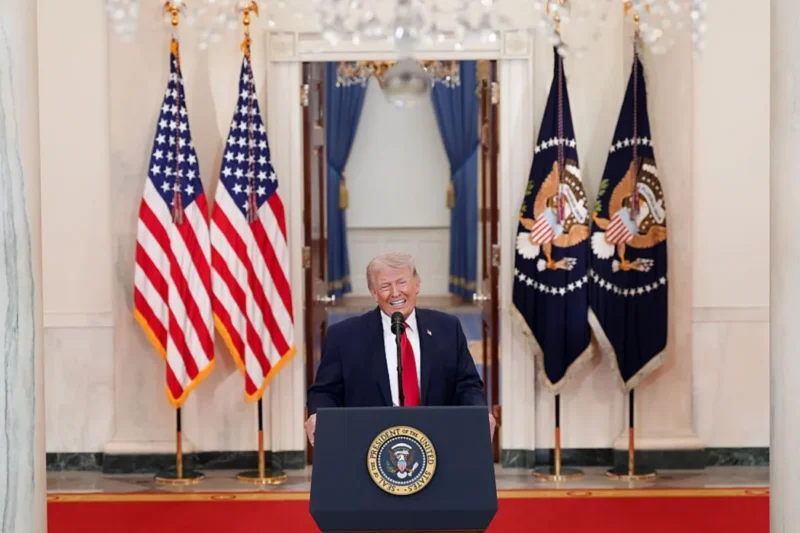
Trump Describes What Happened With Obama Deal
President Donald Trump used his Wednesday night address on Iran to revisit a decision he has long framed as central to his foreign policy record: withdrawing from the 2015 nuclear agreement negotiated under former President Barack Obama.
Speaking in the context of ongoing tensions in the Middle East and what he described as “tremendous progress” under current operations, Trump cast the move as a defining step in confronting Iran’s nuclear ambitions.
He argued that the original agreement—formally known as the Joint Comprehensive Plan of Action—would have allowed Iran to continue advancing toward a nuclear weapon under the cover of international legitimacy.
Trump’s language toward Iran was direct and severe, describing the regime as “fanatical” and “murderous,” and warning that a nuclear-armed Iran would pose what he called an “intolerable threat.” From there, he turned to the Obama-era deal itself, labeling it a “disaster” and emphasizing his decision to terminate U.S. participation as a necessary correction.
He pointed to multiple actions across his time in office, including the 2020 strike that killed Iranian General Qasem Soleimani, but returned repeatedly to the withdrawal from the nuclear deal as the most consequential move. In Trump’s telling, the agreement did not restrain Iran—it enabled it.
A focal point of his criticism was the $400 million cash transfer to Iran in January 2016, part of a larger $1.7 billion settlement tied to a pre-revolution arms dispute. The payment, which coincided with the release of American detainees, has long been a source of political contention. Trump described it as an attempt to “buy respect and loyalty,” arguing that it failed to change Iran’s behavior.
The Obama administration, at the time, maintained that the payment was separate from the nuclear agreement and part of a legal settlement over funds dating back decades. Officials also argued that the JCPOA imposed strict limits and inspection mechanisms designed to delay Iran’s path to a nuclear weapon.

Critics of the deal, including Trump, have consistently rejected that assessment, arguing that sanctions relief provided Iran with resources while only temporarily constraining its nuclear program.
In his remarks, Trump framed his current approach as an extension of those earlier decisions, describing his actions as efforts to “correct” what he sees as the failures of previous administrations. The contrast between the two strategies—negotiated limitation versus withdrawal and pressure—remains one of the clearest dividing lines in U.S. policy toward Iran.