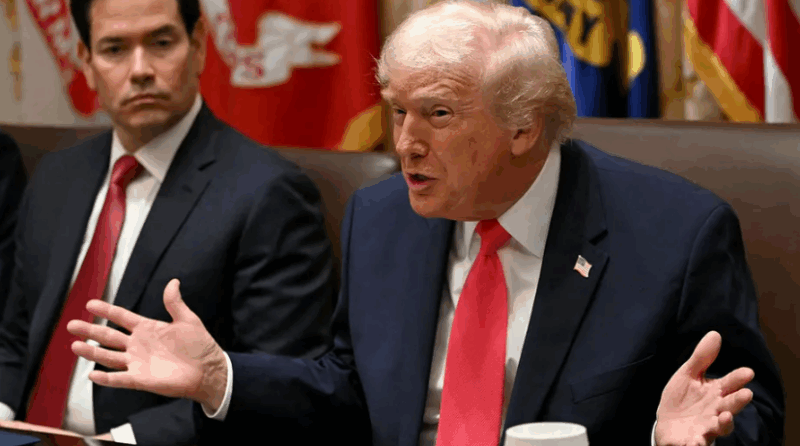
Trump Teases Aggressive New Tax Plan That Would Revolutionize Things
On Tuesday, President Trump rekindled a vision that, for many Americans, has long hovered in the realm of wishful thinking: a future without income taxes. It was a declaration both stunning in its simplicity and monumental in its implications. “At some point in the not too distant future … you won’t even have income tax to pay,” the president said. Whether one sees it as a bold promise or a policy moonshot, the idea immediately captured the imagination of millions of taxpayers.
Trump, never one to shy away from grand declarations, suggested the United States could pivot away from taxing its own citizens and instead rely on tariffs and external revenues—mechanisms he’s repeatedly championed throughout his presidency. “We will tariff and tax foreign countries to enrich our citizens,” he reiterated, nodding to the establishment of the so-called External Revenue Service, a strategic pivot he first introduced in his inaugural address.
BREAKING: President Trump just announced he expects the income tax to be ABOLISHED soon.
This would be the single greatest economic move in American history. Imagine taking home 100% of your paycheck?
The economy would explode overnight. 🚀 pic.twitter.com/aJYqvkUNQy
— Ryan Fournier (@RyanAFournier) December 2, 2025
To be clear: eliminating federal income tax isn’t just a policy adjustment—it’s a tectonic shift in how the United States funds itself. Since the ratification of the 16th Amendment in 1913, the federal income tax has served as the government’s primary revenue source. Replacing it with tariffs, duties, and trade-related levies would require not only economic recalibration but an entire rewrite of modern fiscal orthodoxy.
And yet, Trump’s track record suggests he’s not afraid of that kind of upheaval. From confronting China on trade to overhauling the tax code in 2017, he’s repeatedly shown a willingness to take on deeply entrenched systems. Economist Joseph Lavorgna, now a counselor to Treasury Secretary Scott Bessent, sees promise in the direction. In a recent op-ed, Lavorgna described Trump’s tax strategy as the dawn of a “Golden Age economy,” anchored by disinflationary growth and middle-class prosperity. The so-called One Big Beautiful Bill Act is central to that vision.
Critics, as expected, will raise red flags. The idea of replacing trillions in income tax revenue with tariffs is not without precedent—it’s how America funded itself in the 19th century—but in today’s global economy, skeptics will argue, the math may not square so easily. Tariffs can also carry unintended consequences: higher costs for consumers, trade retaliation, and global market volatility. Still, the theory behind the External Revenue Service is clear: let foreign businesses pay the bill, not American workers.
.@SecScottBessent: “In 2026, we are going to see very substantial tax refunds in the First Quarter… We’re going to see real wage increases. I think next year is going to be a fantastic year.” pic.twitter.com/3XTBD8wK7q
— Rapid Response 47 (@RapidResponse47) December 2, 2025
But there’s more than policy mechanics at play. The cultural resonance of Trump’s tax message—especially with working-class voters and small business owners—is profound. It taps into a longstanding belief that the American tax code is bloated, punitive, and unfairly complex. Replacing it with a simpler, external-facing system represents not just reform, but liberation.
Fox News accurately labeled Trump’s comments as his “most explicit endorsement yet” of ending income taxation. Whether it becomes reality is a matter of political will, economic feasibility, and legislative alignment. But in the lead-up to a pivotal election cycle, the idea is already doing something powerful: shifting the debate.