
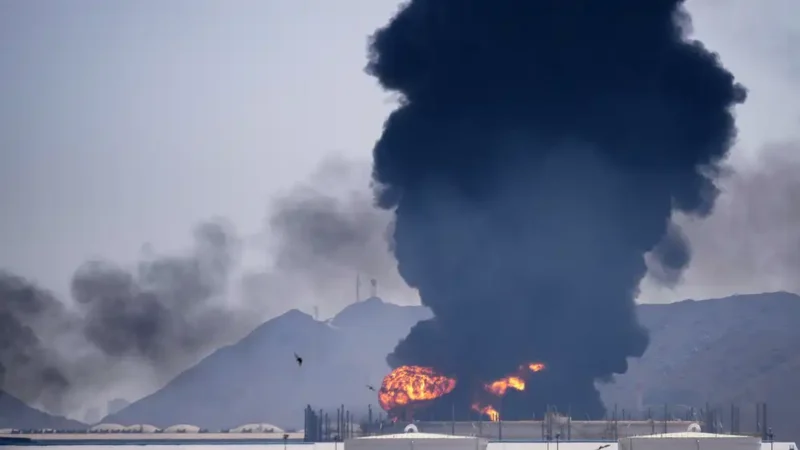
US Unleashes Historic Bombing Raid On Iran’s Key Oil Exports
The strike on Kharg Island marks a dramatic escalation in a conflict that had, until this point, carefully avoided Iran’s most economically vital nerve center. Long regarded as the beating heart of the Islamic Republic’s oil exports, Kharg Island is not merely a strategic asset—it is the axis upon which Iran’s financial stability and geopolitical leverage turn. By targeting military installations on the island while deliberately sparing its oil infrastructure, the United States signaled both overwhelming capability and calculated restraint.
President Trump’s announcement framed the operation as historic in both scale and precision, emphasizing the complete destruction of designated military targets. The language used—“totally obliterated”—was not accidental.
It reinforces a broader narrative of dominance, one that underscores the administration’s assertion that Iran lacks the defensive capacity to counter such strikes. Yet beneath the rhetoric lies a more nuanced strategy: the preservation of oil infrastructure as leverage rather than its immediate destruction.
Kharg Island’s importance cannot be overstated. Handling roughly 90% of Iran’s crude exports, it serves as a financial lifeline for the regime. Analysts have long argued that disabling or capturing the island would effectively sever Iran’s primary revenue stream, triggering cascading effects across its military operations and domestic stability.
The decision not to target these facilities—at least for now—keeps that option in reserve, transforming the island into both a pressure point and a bargaining chip.
The warning tied to the Strait of Hormuz further clarifies this posture. By linking the safety of global shipping routes to the survival of Kharg’s oil infrastructure, the United States has drawn a clear line: interference will invite economic devastation. This conditional threat introduces a layer of deterrence aimed not only at Iran but at any actor considering disruption in one of the world’s most critical maritime corridors.
At the same time, conflicting signals from the administration add complexity. Trump’s earlier dismissal of plans to seize Kharg contrasts sharply with the subsequent strike, illustrating a pattern of strategic ambiguity. This unpredictability may be intentional, designed to keep adversaries off balance while preserving operational flexibility.

Ultimately, the Kharg Island strike represents more than a tactical victory. It is a calculated move in a broader campaign where economic pressure, military precision, and psychological signaling intersect.