
Candidate’s Controversial Prayer Comments Resurface
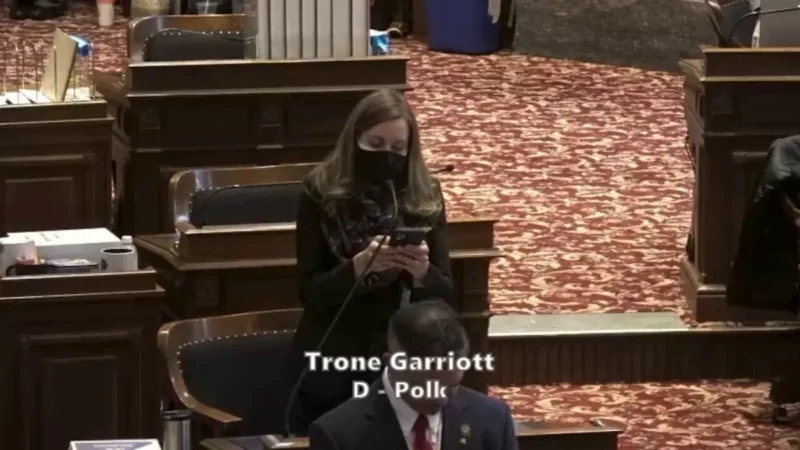
State Sen. Sarah Trone Garriott’s decision to deliver a Muslim prayer on the Iowa Senate floor in 2021 drew international attention at the time, but as she now campaigns in one of the nation’s most competitive congressional races, the episode is returning to the political spotlight in a very different context.
Garriott, a Democrat and ordained minister in the Evangelical Lutheran Church in America, is seeking to unseat Republican Rep. Zach Nunn in Iowa’s Third Congressional District, a battleground seat that could help determine control of the House in 2026. As the race intensifies, critics are revisiting comments Garriott made after the prayer ceremony, arguing they reveal a broader worldview centered heavily on identity politics and representation.
The prayer itself was delivered during a routine Iowa Senate session shortly after Garriott was elected to the state legislature. Rather than offering a Christian prayer, she chose to read a prayer written from an Islamic perspective, highlighting several names and attributes associated with Allah.
“We can all benefit as people of faith and as citizens to grow stronger as a community,” Garriott said before reading the prayer. “So today I’m sharing a prayer from an accomplished young woman in my district.”
Later, during an interview on British Muslim TV with host Mohammed Shafiq, Garriott elaborated on why she believed the moment mattered politically and culturally.
“The Senate begins every day with prayer. And they almost always share Christian prayers,” Garriott explained. “And for me, it’s really important to make sure that the diverse religious communities here and in Des Moines get to have their voice heard.”
She added that she had committed herself to featuring prayers from faith communities outside Christianity.

“I’ve made a commitment to only be praying prayers from those other communities,” she said.
Garriott also argued that Muslims in Iowa had experienced discrimination and hostility, particularly in the Des Moines metro area, which she said justified efforts to elevate minority religious voices in public institutions.
“I just think there is some horrible animosity towards our Muslim neighbors,” she said at the time. “And we have a significant Muslim population in this metro area, and those voices deserve to be heard.”
The comments immediately stood out in Iowa, a state where Christianity overwhelmingly dominates religious affiliation. According to Pew Research Center data, roughly 93% of Iowa residents identify as Protestant, Catholic or religiously unaffiliated. Muslims account for less than 1% of the state’s population, according to the Public Religion Research Institute.
Garriott’s remarks also fit into a broader pattern of criticism she has directed toward what she sees as a lack of diversity among Iowa’s political leadership.
“By being in state government, I can see we have a long way to go in representing our community,” Garriott said in another interview. “It’s not a very diverse group of leaders. We don’t have people from many religious backgrounds — it’s mostly white, mostly Christian.”
Republicans have seized on those comments as evidence that Garriott views Iowa through an ideological lens many voters may reject. During a campaign event this week, Nunn sharply criticized her rhetoric without directly naming the 2021 interview.
“I don’t need a lecture from someone who pretends to preach from the pulpit while at the same time doing things like tell Americans that they’re too white and too racist,” Nunn said. “I don’t believe that’s true.”
Republican National Committee spokesperson Zach Kraft went even further, accusing Garriott of building her political profile by criticizing her own state and country before international audiences.
“It is downright shameful to go on a foreign television show and call Americans racist and backwards,” Kraft said.